1970s Fashion: Disco, Bohemia, and the Birth of Punk
If the 1960s pulled fashion apart, the 1970s ran with the pieces. The decade had no single silhouette — it had four or five, often worn on the same street on the same night. Hippie, glam rock, disco, punk, and a new working-woman professional wardrobe all coexisted, often in the same closet.
The cultural backdrop
The 1970s opened in disillusionment. The Vietnam War ground on until 1975. The 1973 oil crisis ended the post-war boom. Watergate broke in 1972 and ended Richard Nixon's presidency in 1974. Stagflation, gas lines, and rising unemployment defined the early decade in the West. At the same time, second-wave feminism reorganized women's relationship to work; the contraceptive pill was now widespread; the first openly gay rights movements organized after the 1969 Stonewall uprising.
Music drove fashion harder than at any time before or since. Glam rock (David Bowie, T. Rex, Roxy Music) led to glittered androgyny. Disco — born in New York gay clubs and exploding into the mainstream after Saturday Night Fever (1977) — brought polyester, sequins, and the leisure suit. Punk emerged in London and New York in 1976–77 as a violent rejection of disco, glam, and corporate rock alike. By the end of the decade, fashion was no longer trying to express one idea — it was a vocabulary of subcultures.
Women's fashion: the bohemian decade
Early 1970s: hippie continued
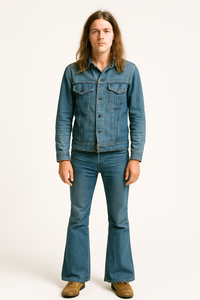
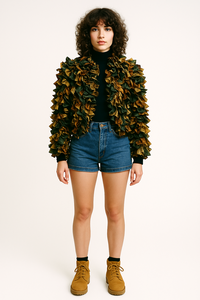
The first three years of the 1970s were essentially the late 1960s with the volume turned up. Bell-bottom jeans got wider; peasant blouses got more embroidered; maxi skirts got more patchwork. Patchouli, embroidery from Afghanistan and India, Native American silver jewelry, and macramé everything defined the bohemian wardrobe. Crochet vests, halter tops, and hot pants (introduced in 1971 as a brief winter answer to the maxi skirt) all found their place.
Mid-1970s: the wrap dress and disco
In 1974, a 26-year-old Diane von Furstenberg launched a printed jersey wrap dress that became one of the decade's defining garments — by 1976 her company was selling 25,000 a week. The wrap dress signaled a new kind of women's wardrobe: a piece you could throw on, work in, and dance in. Halston, working out of New York, defined an opposing high-luxury look — fluid jersey halter dresses and one-shoulder columns in jewel tones, worn at Studio 54.
Disco fashion was its own ecosystem: lurex and metallic lamé, jumpsuits with deep V-necks, sequined boob tubes, hot pants in glitter spandex, platform shoes (often four inches or higher), and the wrap-around polyester shirt-dress. Fabric was synthetic — polyester, lurex, lycra, qiana — and it was supposed to look unmistakably synthetic.
Late 1970s: working-woman tailoring and punk
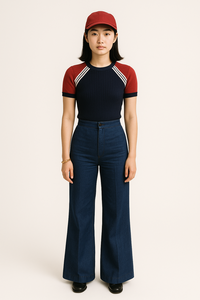
By 1977 the working women entering offices in record numbers needed clothes that didn't read as either hippie or disco. Calvin Klein, Ralph Lauren, and Yves Saint Laurent built a softer tailored wardrobe — wide-leg trousers, blazers, blouses with pussy bows, knee-length pencil skirts — that would crystallize into 1980s power dressing.
Punk arrived in 1976. Vivienne Westwood and Malcolm McLaren's London shop SEX (later renamed Seditionaries) sold ripped T-shirts with safety pins, bondage trousers with straps, tartan kilts, mohair sweaters, and slogans that horrified the British press. The look spread through the Sex Pistols, the Clash, and Sid Vicious into a global subculture. Its commercial influence was small in the 1970s but enormous afterward.
Men's fashion: the leisure suit, glam, and punk
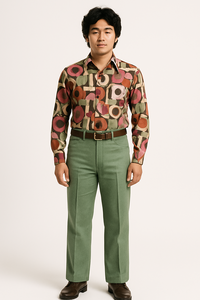
The 1970s is the decade most associated, fairly or not, with men's fashion mistakes. Bell-bottoms, polyester safari suits, "leisure suits" in coordinated polyester (jacket and trousers in the same fabric, often pastel), wide pointy collars on patterned shirts, kipper ties up to five inches wide at their widest, and the disco-era three-piece in white polyester (immortalized by John Travolta) all date from this decade.
Glam rock pulled menswear into territory it hadn't seen since the 18th century: David Bowie's Ziggy Stardust era used sequined jumpsuits, eye shadow, painted-on lightning bolts, and platform boots; Bryan Ferry of Roxy Music wore tuxedos with tiger-print shirts. By the late decade, punk's contribution to menswear was an anti-fashion uniform — drainpipe jeans, Doc Martens or creepers, leather jackets, ripped T-shirts held together with safety pins, and chunky belts.
Outside subcultures, the conservative man's silhouette became wider: wider lapels, wider ties, wider trousers. Beards, mustaches, and long hair became standard for a generation that the 1950s would have called "unkempt."
Hair, makeup, and accessories
The decade's most-copied women's hairstyle was Farrah Fawcett's feathered, layered shoulder-length blowout from Charlie's Angels (1976) — the "Farrah flick." Long, ironed-flat center-parted hippie hair carried over from the 1960s; afros became powerful symbols of Black political identity; the Dorothy Hamill bob (1976) and the shag (popularized by Jane Fonda in Klute, 1971) were the major haircut alternatives.
Makeup softened in the daytime — earth tones, bronzer, peach lipstick — and exploded at night. Disco makeup added blue and lavender shadow up to the brow, glitter on the cheekbones, glossy nude or fuchsia lips. Punk makeup used kohl heavily, dark lipstick, and bleached or dyed-black hair.
Accessories: platform shoes (cork, wood, or stacked leather), wide leather belts, mood rings, peace-sign and zodiac jewelry, Pucci silk scarves, oversized sunglasses, choker necklaces, and the ubiquitous fringed suede shoulder bag. The "Annie Hall" look (1977, courtesy of Diane Keaton and Ralph Lauren) — men's blazer, baggy trousers, vest, fedora, men's tie — pulled menswear into the womenswear mainstream where it has stayed.
Icons of the decade
- Diane von Furstenberg — The wrap dress, 1974. A garment that says "modern working woman" in three seconds.
- Bianca Jagger — White suit at her wedding to Mick (1971); riding a white horse into Studio 54 in 1977. The disco era's most photographed woman.
- Halston — Roy Halston Frowick. Defined American high luxury on the Studio 54 dance floor.
- David Bowie — Whose multiple personas (Ziggy Stardust, the Thin White Duke, the Berlin trilogy) reorganized what men could wear.
- Cher, Stevie Nicks, Farrah Fawcett — Three different American style archetypes (glam goddess, gypsy witch, beach blonde) that have all returned in revival cycles.
- Vivienne Westwood and Malcolm McLaren — The architects of punk style.
- Yves Saint Laurent — Whose Le Smoking, peasant collections, and ready-to-wear line Rive Gauche made him the most influential designer of the decade.
Gallery
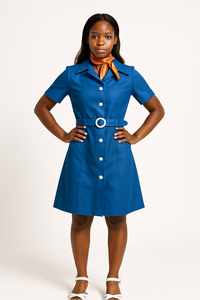
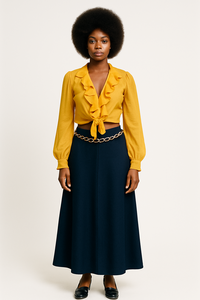
How to recreate the 1970s look today
- Bohemian: wide-leg flared jeans or a maxi peasant skirt, an embroidered or paisley blouse, a fringed suede vest, a wide-brimmed felt hat, layered turquoise jewelry, long flowing hair.
- Disco: a fitted halter jumpsuit in metallic lurex or jersey, platform shoes, hoop earrings, frosted shimmery makeup, a long shag or Farrah-style blowout.
- Late-70s working woman: a printed jersey wrap dress (DVF and her many copies still sell them), tortoise sunglasses, a tan trench, knee-high boots, a soft side-parted blowout.
- Punk: drainpipe black jeans, a band T-shirt under a leather jacket, Doc Martens, a studded belt, kohl-rimmed eyes, choppy hair.
Common identification mistakes
- vs. late 1960s: the early-1970s hippie look is essentially identical to the late-1960s hippie look. Polyester surfaces, wider bell bottoms, and platform shoes push an outfit firmly into the 1970s.
- vs. early 1980s: late-1970s tailoring (wide lapels, soft shoulders, blouses with pussy bows) overlaps heavily with early-1980s tailoring. Once shoulders go obviously square and padded, you've crossed into the 1980s.
Upload a photo and the AI will tell you which decade it matches.