1940s Fashion: Wartime Utility and the New Look
More than any other decade of the 20th century, 1940s fashion is a story of two halves. Until 1945, what people wore was shaped almost entirely by the Second World War — by rationing, by women joining the workforce, by literal shortages of zips, elastic, and silk. After 1947, a single Paris collection redrew the silhouette in twenty minutes and started the post-war boom in style.
The cultural backdrop
The Second World War broke out in September 1939 and dominated everyday life until August 1945. Britain introduced clothing rationing in June 1941; the United States followed in 1942 with War Production Board "L-85" regulations limiting fabric use. There were rules about how many buttons a jacket could have, how deep a hem could be, how many pockets a skirt could include. Wool, silk, and leather were prioritized for the military. Nylon — invented in 1938 — disappeared from the consumer market because every yard went into parachutes.
For the first time, vast numbers of women were in factories, fields, and uniforms. The American "Rosie the Riveter" image — a woman in coveralls with her hair tied up in a bandanna — was real, not just a poster. Across the world, the silhouette of fashion came to mirror military tailoring: square shoulders, narrow waists, and clean, no-nonsense lines.
Women's fashion: utility, then explosion
1940–1947: the utility years
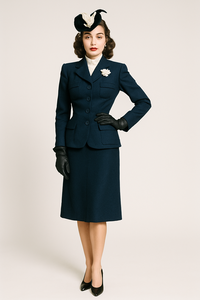
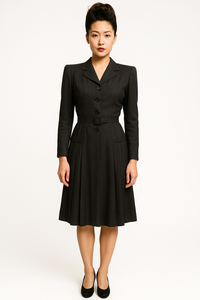
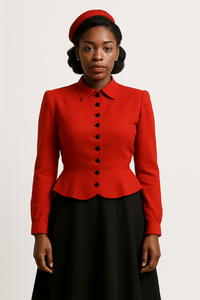
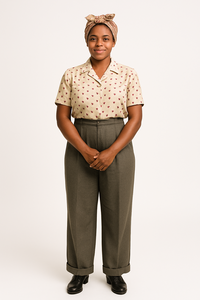
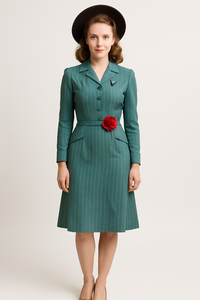
British "Utility" clothing (the CC41 mark on garments) and American L-85 dressing produced a remarkably consistent global silhouette: a knee-length skirt or dress with a matching tailored jacket, padded square shoulders, a narrow waist, and minimal trim. Patch pockets replaced flap pockets. Buttons replaced zips. Hemlines hovered just below the knee. This was the period of the "victory suit," the shirtwaist day dress, and tailored separates that could be mixed and matched to stretch a wartime wardrobe.
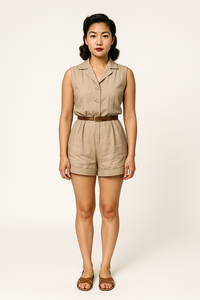
With silk stockings unavailable, women drew "stocking seams" up the back of their bare legs with eyebrow pencil and stained their skin with leg makeup or strong tea. Headscarves tied turban-style protected hair from factory machinery and became, by 1942, a fashion item in their own right. Trousers — once scandalous on women — became respectable workwear and never went away.
1947–1949: Dior's New Look
On February 12, 1947, an unknown designer named Christian Dior showed his first collection at 30 Avenue Montaigne in Paris. American Harper's Bazaar editor Carmel Snow declared, "It's quite a revolution, dear Christian. Your dresses have such a new look." The name stuck. Dior's "Bar suit" — a soft cream silk jacket with a tiny waist and rounded hips, paired with a black wool skirt that used a full fifteen yards of fabric — was a deliberate provocation after years of rationing. Hemlines dropped to mid-calf. Bosoms returned. Hips were padded. Shoulders softened.
The reaction was extreme. Women wrote angry letters about the "wasteful" fabric use; some British papers called for the look to be banned. Within eighteen months almost every fashionable woman in the West was wearing some version of it. The full-skirted, cinched-waist silhouette would dominate the next decade.
Men's fashion: the demob suit and the zoot suit
For most men of the early 1940s, "fashion" meant a uniform. When servicemen were demobilized after 1945, the British government issued each man a "demob suit" — a free three-piece in navy, brown, or grey wool. The cut was wide-shouldered, double-breasted, and slightly oversized; for many returning soldiers it was the first new suit they had owned in six years. The double-breasted demob silhouette dominated post-war menswear into the early 1950s.
An important counter-current was the zoot suit, popular in African American, Mexican American, and Filipino American communities in the early 1940s. Zoot suits had absurdly high-waisted, voluminous "reet pleated" trousers; jackets reached the knee with extreme padded shoulders; finished with a wide-brimmed hat and a long watch chain. Zoot suits used so much fabric that wartime authorities considered them unpatriotic, and the 1943 Zoot Suit Riots in Los Angeles turned them into a flashpoint of cultural conflict.
Hair, makeup, and accessories
Women's hair grew long again — usually shoulder-length, often with bangs — and the dominant style was a sculpted set of rolls and pin curls. The "victory roll" (two large rolled sections at the front of the head, sometimes meeting in the middle) is the most recognizable hairstyle of the decade. Headscarves and snoods kept long hair tidy at work. Pageboy bobs were popular for younger women and teenagers.
Makeup was simpler and more uniform than in the 1930s. Red lipstick — actively encouraged as a morale booster, with brands like Elizabeth Arden's "Victory Red" and Helena Rubinstein's "Regimental Red" — became almost a uniform. Eyebrows were thicker and more natural. Foundation and rouge stayed light.
Accessories were limited by rationing but inventive: cork or wedge soles (introduced by Salvatore Ferragamo when leather ran short), wooden-soled platforms, fabric-covered handbags, and elaborate hats (which, oddly, were never rationed and so became the one place a wartime woman could indulge in fabric and feathers).
Icons of the decade
- Christian Dior — The 1947 New Look ended the decade and started the next.
- Rita Hayworth — Whose pin-up photo in Life magazine made her the most-requested image among American servicemen.
- Lauren Bacall — The model and actress whose 1944 Harper's Bazaar cover, in a tailored suit, defined wartime sophistication.
- Ingrid Bergman — Trench coats, side-parted waves, and the kind of restrained glamour that fit a serious decade.
- Claire McCardell — The American designer who invented "American sportswear": separates, denim, ballet flats, and the popover dress, a working-woman's wardrobe answer to French couture.
- Salvatore Ferragamo — Whose cork-wedge platforms (born of leather rationing) became one of the decade's signature shoes.
Gallery
How to recreate the 1940s look today
- For wartime utility: a knee-length A-line skirt, a fitted blouse with small puffed shoulder, a tailored jacket with strong shoulder pads, sensible Oxford-style heels, and a small tilt hat.
- For New Look elegance: a full mid-calf circle skirt, a fitted bodice with a tiny waist (cinch belt if needed), nude stockings, low-heeled court shoes, white gloves, a small structured handbag.
- Hair: two victory rolls at the front, the rest of the hair brushed into soft shoulder-length waves. A bandanna or small headscarf for casual days.
- Makeup: matte foundation, soft brown brows, a single coat of black mascara, and a true red matte lipstick.
Common identification mistakes
- vs. 1930s: 1930s shoulders are soft and rounded; 1940s shoulders are hard, square, and padded. 1930s skirts flow; 1940s skirts are knee-length and angular until 1947.
- vs. 1950s: the late 1940s New Look (1947–1949) and early 1950s look are nearly identical — both feature small waists and full skirts. The clue is hem length: late 1940s hems are mid-calf; 1950s hems rise gradually toward the knee through the decade.
Upload a photo and the AI will tell you which decade it matches.