1950s Fashion: Full Skirts, Greasers, and the Birth of the Teenager
The 1950s gave the world two wardrobes that have refused to die: the cinched-waist, full-skirted housewife in pearls and red lipstick, and the leather-jacketed, denim-clad rebel with a duck's-tail pompadour. Both were inventions of the decade. Both still hang in the back of every retro shop in the world.
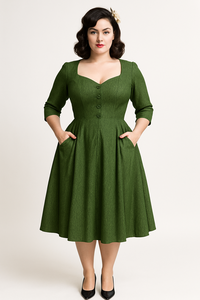
The cultural backdrop
The 1950s in the United States and Western Europe were defined by economic recovery and consumer abundance after fifteen years of depression and war. American suburbs exploded; television entered the average home; refrigerators, washing machines, and family cars became standard. The decade idealized the nuclear family and the housewife, even as huge numbers of women had spent the previous decade working in factories and offices.
It was also the decade that invented the teenager — a category that simply hadn't existed before, when adolescents had dressed like smaller adults. Now, thanks to disposable income, a separate teenage wardrobe and music industry took shape. Rock and roll arrived; James Dean and Marlon Brando broke through; Seventeen and similar magazines created a youth fashion vocabulary that ran in parallel to the adult one. The tension between conformity and rebellion is the decade's defining style story.
Women's fashion: the New Look perfected
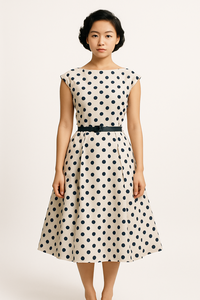
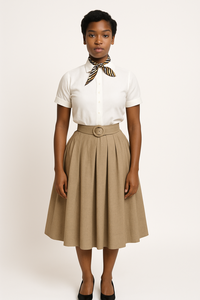
Christian Dior's 1947 New Look became the default 1950s daytime silhouette: a fitted bodice, a tiny waist, a full mid-calf skirt held out by petticoats. Dior himself dominated the early decade with collections that named each new line — the H-line (1954), the A-line (1955), the Y-line (1955) — and dictated millimeters of hemline change to a global audience. After Dior's death in 1957, his 21-year-old assistant Yves Saint Laurent took over the house and showed the looser "Trapeze" line in 1958, hinting at the youthful 1960s to come.
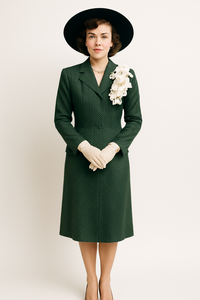
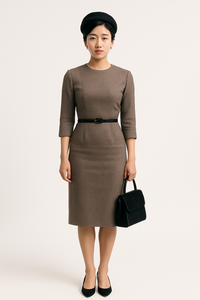
The other dominant silhouette was the sheath or wiggle dress: a slim, knee-length, body-hugging dress, often with a matching jacket — a look defined by Cristóbal Balenciaga and worn by everyone from Jackie Kennedy to Marilyn Monroe. Where the full skirt said "domestic," the sheath said "office" or "cocktail."
Daywear
- Shirtwaist dresses: button-front bodice, full skirt, often in gingham or floral cotton
- Pencil skirts and knit twinsets — sweater plus matching cardigan plus pearls
- Capri pants (popularized by Sonja de Lennart and Audrey Hepburn) and "pedal pushers" for casual wear
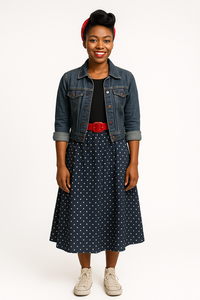
- Saddle oxfords or kitten heels; bobby socks for teenagers
Evening wear
- Strapless ball gowns with full tulle skirts (the Cinderella silhouette of the decade)
- Cocktail dresses just below the knee in satin, brocade, or organza
- Long opera gloves, fur stoles, and clutch bags
Men's fashion: gray flannel, Ivy League, and the greaser
The dominant adult male look of the 1950s was the gray flannel suit — narrow lapels, single-breasted, white shirt, slim tie — immortalized by Sloan Wilson's 1955 novel The Man in the Gray Flannel Suit. American "Ivy League" or "preppy" style took shape on East Coast campuses: button-down Oxford shirts, chinos, penny loafers, crewneck sweaters, and the now-iconic Brooks Brothers sack suit. This is the wardrobe that would later be called "trad" and that has been reissued by every menswear revival since.
Alongside the office suit ran two distinct youth subcultures. American greasers — inspired by Brando in The Wild One (1953) and Dean in Rebel Without a Cause (1955) — wore white T-shirts (often with a pack of cigarettes rolled into the sleeve), Levi's 501 jeans rolled at the cuff, leather motorcycle jackets, and pomaded ducktail haircuts. British Teddy Boys — the first identifiably "teenage" subculture in the UK — wore Edwardian-revival drape jackets with velvet collars, drainpipe trousers, brothel creepers, and slicked quiffs. Both looks refused the gray flannel uniform and pointed toward the youth-driven decades that would follow.
Hair, makeup, and accessories
For adult women, hair was short to medium length, set in lacquered, structured curls — the bouffant, the poodle cut, and the short pixie all originated or peaked in this decade. Audrey Hepburn's gamine pixie in Roman Holiday (1953) was a sensation. Marilyn Monroe's platinum waves were the ultimate bombshell counterpart.
Makeup was high-contrast and graphic: porcelain matte foundation, defined dark brows, a strong winged liquid eyeliner (popularized by Audrey Hepburn and Brigitte Bardot), heavy mascara, and a saturated red or coral lip. Cat-eye glasses became a fashion item, not just a vision aid.
Key accessories included white short gloves for daytime, pillbox hats, kitten-heeled mules, kitten-heeled court shoes, structured top-handle bags (the Hermès Kelly was renamed for Grace Kelly in 1956), and silk headscarves tied under the chin.
Icons of the decade
- Audrey Hepburn — Whose collaboration with Hubert de Givenchy on Sabrina (1954) and Funny Face (1957) defined a slim, urban, gamine alternative to the bombshell.
- Marilyn Monroe — The platinum, hourglass, sweetheart-necklined embodiment of mid-decade Hollywood.
- Grace Kelly — Whose sleek, patrician style — and 1956 marriage to Prince Rainier of Monaco — connected old Hollywood to European royalty.
- Brigitte Bardot — France's answer to Monroe; gingham, ballet flats, eyeliner, and the deliberately undone "tousled" hairstyle.
- James Dean and Marlon Brando — Whose on-screen wardrobes built the greaser archetype that has outlasted nearly every other decade's youth look.
- Christian Dior, Cristóbal Balenciaga, Hubert de Givenchy — The three Paris houses whose collections set the global silhouette.
Gallery
How to recreate the 1950s look today
- For the housewife/rockabilly silhouette: a fitted bodice top, a knee-length circle or A-line skirt with a cinch belt, a petticoat for fullness, kitten heels, white short gloves, and a small structured handbag.
- For the wiggle/sheath look: a knee-length pencil dress with a small jacket, kitten heels, pearls, cat-eye sunglasses.
- For the greaser: white T-shirt, Levi's 501 jeans rolled at the cuff, black leather motorcycle jacket, black engineer or chukka boots, hair slicked back with pomade.
- Hair: short curled set with a side parting, or a high ponytail tied with a silk scarf for the teenage version.
- Makeup: matte porcelain skin, dark brows, winged eyeliner, true red lips, no contouring.
Common identification mistakes
- vs. late 1940s: the New Look starts in 1947, so 1947–1949 looks read as either decade. Hem length is the clue: longer mid-calf is late 1940s; rising hems toward the knee say 1950s. Petticoats fluffed to maximum width are mid-decade 1950s.
- vs. 1960s: early 1960s and late 1950s blur. The Jackie Kennedy pillbox-and-shift look lives in both decades. By 1964, hemlines have risen above the knee and the silhouette has straightened — that's a clear 1960s tell.
Upload a photo and the AI will tell you which decade it matches.